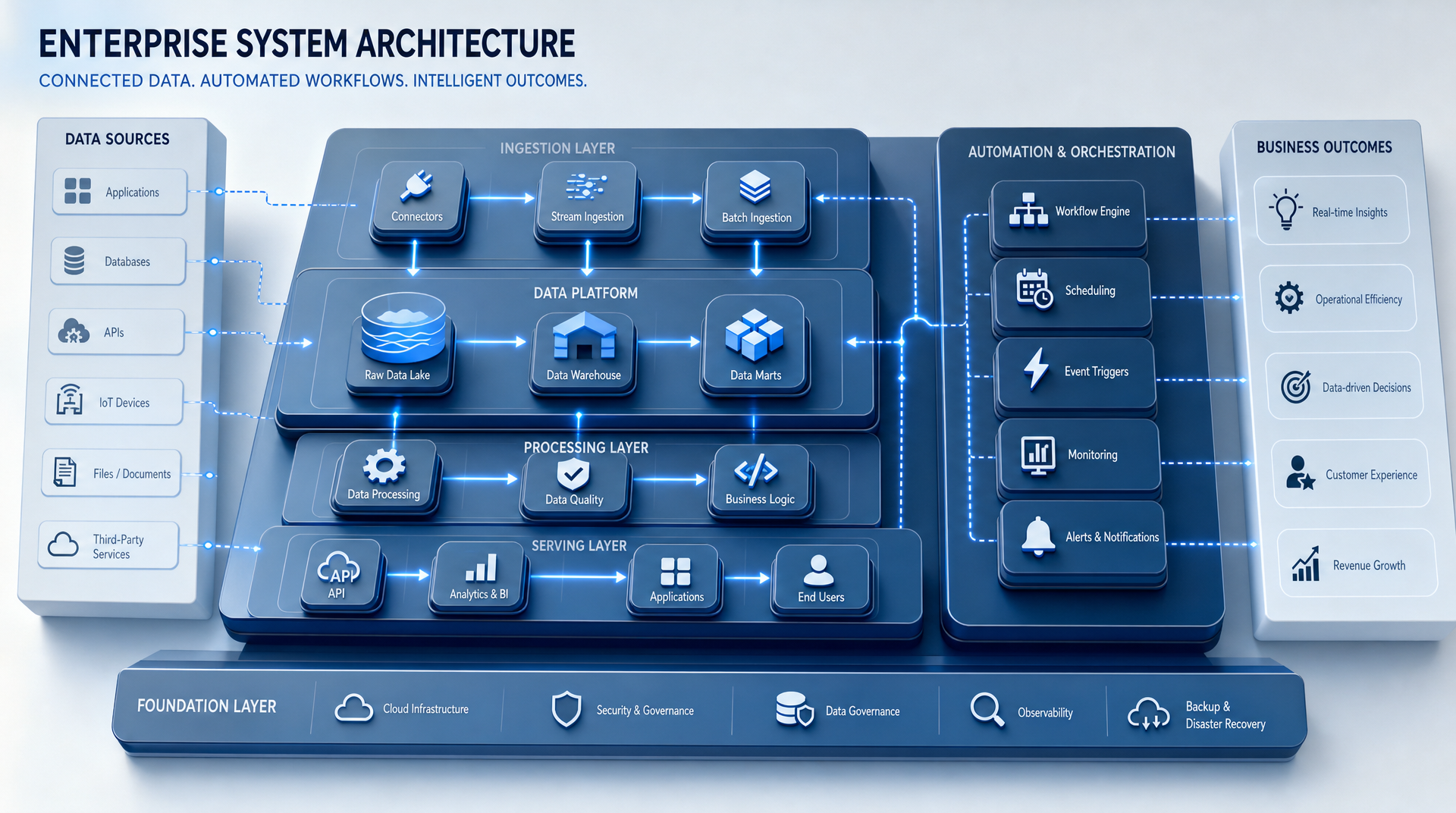
Web Solutions architects observable technology systems — connecting architecture, data, automation, and intelligent agents into workflows your team can trust, measure, and continuously improve.
ARCHITECTURE VIEWEvery node observable. Every flow traceable.
Core Capabilities
Four pillars of observable operations.
Each module stands alone and connects with the others — forming a complete technology foundation that grows with your organization.
01
System Architecture
Durable foundations built for growth. We design modular, documented architectures that make every component's role, boundary, and dependencies explicit — so your next decision is always clearer than your last.
Domain-driven modular design
Failure-mode analysis built in
Scalability roadmap included
02
Data Integration
Connected information with clear ownership, lineage, and governance. We unify siloed data sources into trustworthy streams — eliminating blind spots without creating brittle point-to-point spaghetti.
API-first integration layer
Real-time & batch pipelines
Data quality monitoring
03
Process Automation
Repeatable work that runs reliably and leaves a comprehensive audit trail. We automate the deterministic parts of your operations so your team focuses on judgment, creativity, and exception handling.
Event-triggered workflows
Full execution audit logging
Human-in-the-loop checkpoints
04
Intelligent Agent Operations
AI agents with observable actions, defined authority limits, and human oversight. We design agent systems that augment your team — not replace it — with clear escalation paths and explainable decisions.
Bounded autonomy frameworks
Decision traceability logs
Confidence-threshold gating
Integration Capabilities
Everything connects. Nothing is a black box.
Our integration layer ensures every component — legacy, modern, custom, or third-party — participates in a single observable system.
✓
Legacy System Modernization
Wrap existing systems with modern APIs without risky rip-and-replace cycles. Incremental migration, not big-bang disruption.
✓
Multi-Cloud Orchestration
Unified control plane across AWS, Azure, GCP, and on-premise — with consistent monitoring, security policy, and cost visibility.
✓
Real-Time Event Streaming
Apache Kafka and NATS-based pipelines that deliver sub-second data propagation across your entire system topology.
✓
API Gateway & Management
Rate limiting, authentication, versioning, and developer portals — all managed through a single observability dashboard.
✓
Observability & Alerting
OpenTelemetry-native tracing, structured logging, and intelligent alerting that reduces noise and surfaces what matters.
✓
Security & Compliance Automation
Automated policy enforcement, audit-ready evidence collection, and continuous compliance monitoring across SOC 2, HIPAA, and ISO 27001.
Case Studies
Measurable outcomes. Repeatable patterns.
FinTech
Real-Time Payment Reconciliation
A multinational payment processor replaced a nightly batch reconciliation with an event-driven architecture. The new system processes 2.3M transactions/day with sub-second settlement visibility.
−94%Reconciliation latency
2.3MTransactions/day
ZeroUnreconciled gaps
Healthcare
Clinical Data Interoperability Layer
A regional hospital network integrated 12 disparate EHR systems into a single FHIR-compliant data fabric. Clinicians now access unified patient records across all affiliated facilities.
12→1Systems unified
−78%Chart retrieval time
HIPAACompliant by design
Logistics
Automated Supply Chain Exception Handling
Intelligent agents now detect shipment anomalies, assess severity, and either auto-resolve or escalate to human operators — reducing exception resolution time from hours to minutes.
−87%Resolution time
64%Auto-resolved
24/7Coverage
Turn your next bottleneck into a system.
Tell us about the workflow that's difficult to see, maintain, or improve. We'll start by mapping it — at no cost and with no obligation.